Everyone seems to have heard about the Age of Aquarius. Depending on which astrologer you consult, we have either begun or will soon begin the Aquarian Age. But what exactly is the Age of Aquarius?
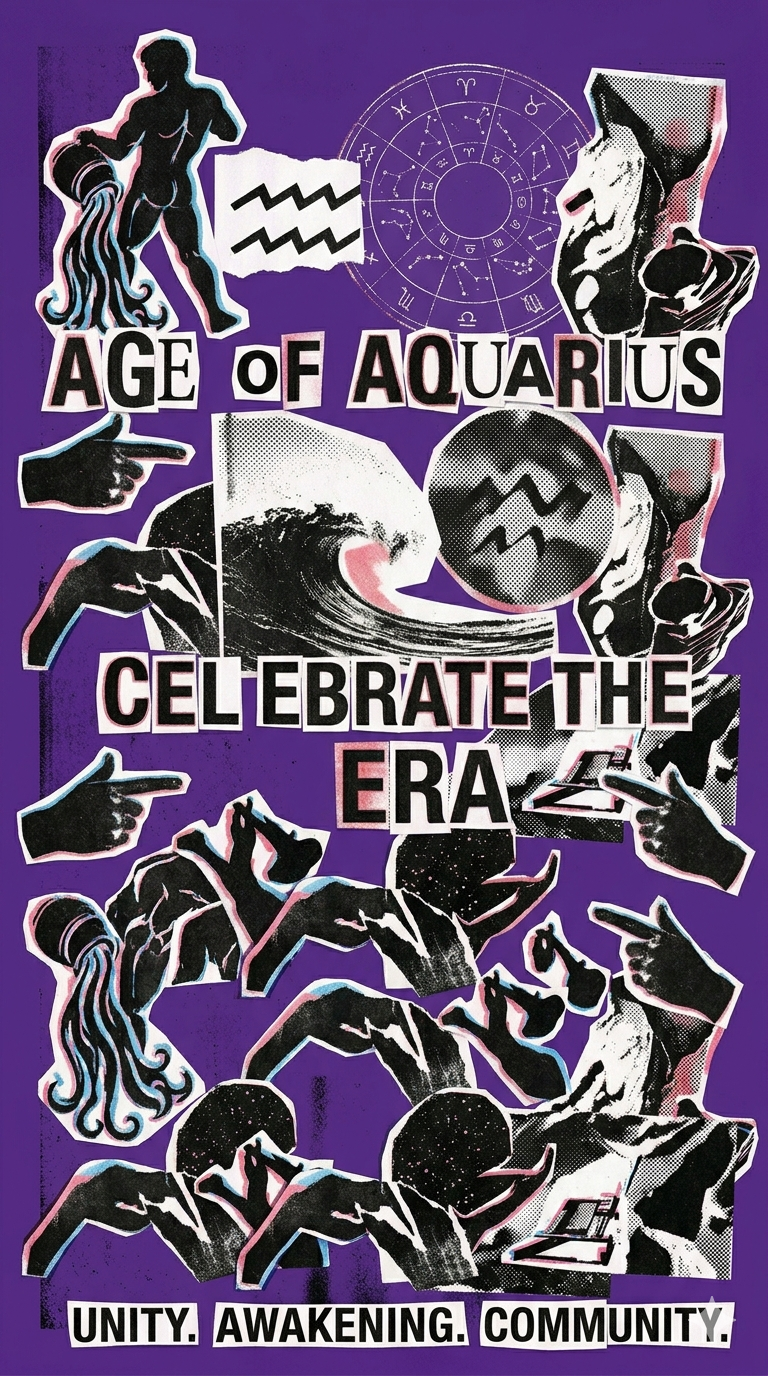 To answer that question, we must backtrack a little. As you know, looking at the Sun from our vantage point here on Earth, it travels around the Earth once every year. On its journey, the Sun travels a narrow path (called the ecliptic), and passes through the twelve signs of the zodiac.
When the foundation stones of the science of astrology were first formally put in place in Babylonian times, the signs of the zodiac were named after actual constellations of stars in the sky. Those early astronomers had noticed that the Sun journeyed through the same constellations every year. During the spring, the path of the Sun crossed over the constellation of Aries. In the fall, the path of the Sun crossed over the constellation of Libra.
The beginning of the astrological year is a point called the vernal equinox. This is where the Sun’s path crosses the celestial equator (the line that divides the heavens into a northern half and a southern half). At that point, day and night are equal in length. The word equinox comes from the Latin, meaning “equal night” (i.e., night is equal to the day). There are two equinoxes during the year, vernal and autumnal. The vernal equinox begins spring; the autumnal equinox begins autumn. The vernal equinox also begins the first astrological sign (Aries) and the first half of the zodiac; the autumnal equinox begins the seventh sign (Libra) and the second half of the zodiac. When astrology was first formalised, the vernal equinox signaled the beginning of the Sun’s entrance not only into the sign of Aries but also into the constellation of Aries. At that time, the two were considered to be identical. Since then, however, astrology and astronomy have diverged. The signs of the zodiac no longer correspond to the same constellations in the sky. Thus, nowadays, when an astronomer talks about Taurus, he or she means the actual group of stars in the heavens that make up the constellation of Taurus.When an astrologer talks about Taurus, he or she refers to the second astrological sign, that 30° segment of the zodiac that controls a whole set of characteristics, symbols, and associations.
It was in the second century B.C. that a Greek astronomer named Hipparchus discovered a phenomenon called the precession of the equinoxes. He found that, ever so slowly, the Earth shifts in its position as it spins through the solar system. Scientists sometimes refer to this slight shift as the Earth’s “wobble,” because it somewhat resembles a top wobbling as it spins. Instead of remaining upright, the poles of the Earth, like the top and bottom of a spinning toy, lean from side to side as the Earth rotates on its axis. Over the span of a great many years, this leaning of the Earth changes the placement of the celestial equator, because the celestial equator is on the same line as the Earth’s equator except that it is projected out into the heavens. Therefore, as the position of the Earth shifts, the line of the celestial equator shifts.
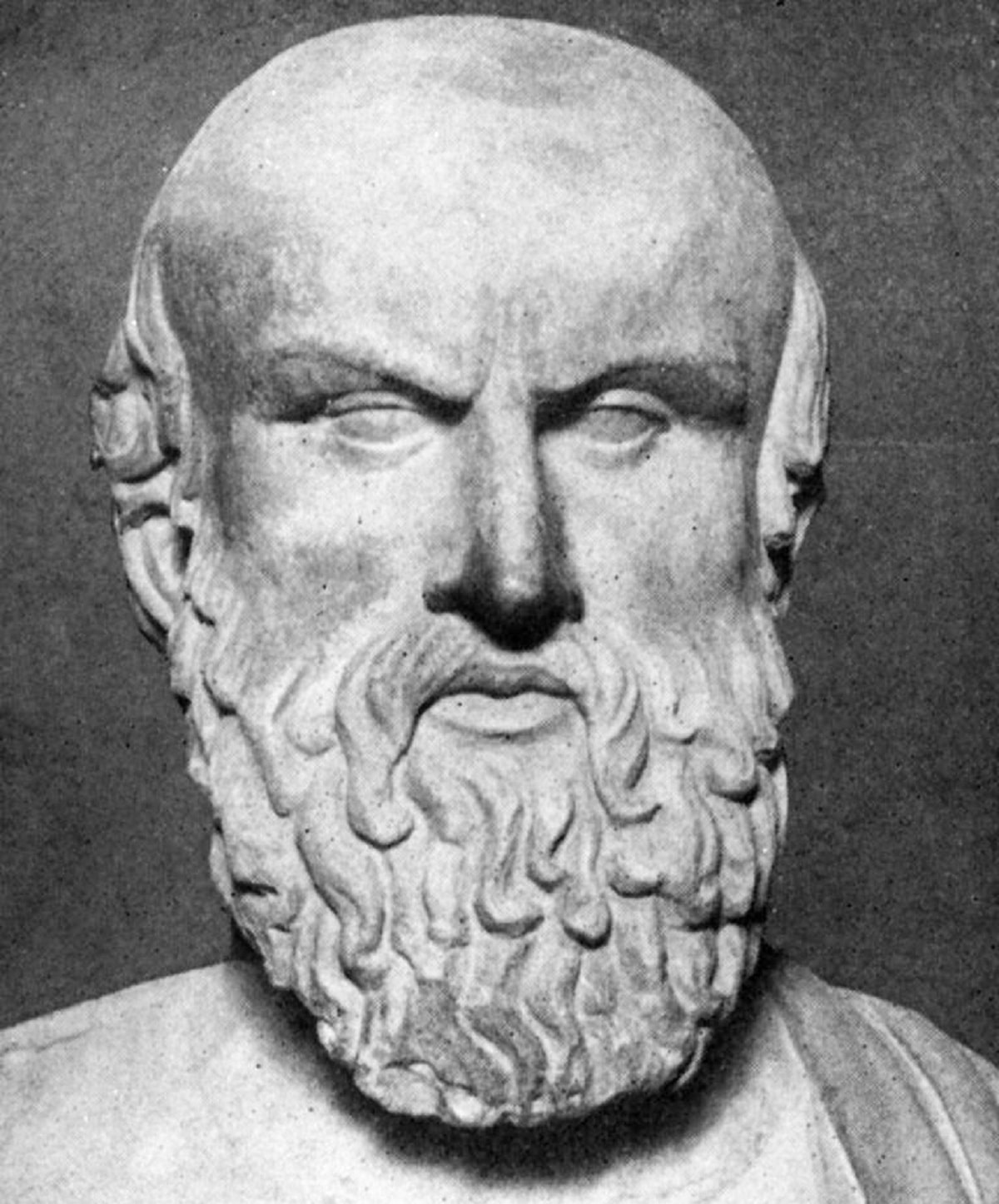
Hipparchus
All of this adds up to the fact that as time passes, the vernal equinox (the point where the path of the Sun crosses the celestial equator) takes place in an entirely different constellation. This slow motion of the Earth’s tilt is called the precession of the equinoxes because, during the span of many, many years, the equinoxes slowly travel through all the constellations of the zodiac, in backward order. (If they travelled in forward order, no doubt it would have been called the procession of the equinoxes.)
When the Babylonians calculated the zodiac, the vernal equinox took place in the constellation of Aries. Around the time of the birth of Christ (the beginning of A.D.), the Earth had shifted enough so that the vernal equinox took place in the constellation of Pisces. Around the year A.D. 2000, the vernal equinox began to take place in the constellation of Aquarius. Hence, “this is the dawning of the Age of Aquarius.”
Little by little, at the infinitesimal rate of approximately 1 degree every 71⁄2 years, the equinoxes move through the zodiac. In the space of about 2,150 years, the equinoxes move through one sign of the zodiac. In the time span of approximately 25,820 years, the equinoxes move through the entire twelve signs of the zodiac. This 26,000-year time span is called a Great Year. Each 2,100-year transit through a sign is called a Great Month; a Great Month is also referred to as an Age. For the past 2,000 years or so, mankind was living in the Age of Pisces; we have now entered the Age of Aquarius. Because such vast amounts of time are involved, it is difficult to give an exact year to the beginning of a new Age. For example, some astrologers mark the beginning of the Aquarian Age at the end of World War Two. The venerable astrological association, the Church of Light, puts the date as early as 1881. Astrologer Capel McCutcheon believed we entered the new Age in the 1970s with the advent of the computer. The psychologist Carl Jung and the astrologer Charles Jayne both predicted that the new Age would begin during the decade of the 1990s. Others, like the Irish astrologer Cyril Fagan, set the date as far ahead as 2300–2400. The consensus, however, is that as of the year 2000 we were definitely in the Age of Aquarius.
Each Age is characterised by the astrological sign of that era. During its existence, our earth has gone through thousands of Great Years. Scientists estimate our Earth to be as old as 4.6 billion years, which means that it has passed through almost 177,000 Great Years. But humankind’s ancestors, creatures who first walked upright on two legs, have been on Earth for only 115 Great Years (3 million years). And Neanderthal Man walked this earth only nine Great Years ago. Astrologers trace mankind’s written history only as far back as the Age of Leo.
AGE OF LEO (circa 10,000 B.C. to 8000 B.C. )
This Age is characterised by the energy and creativity of human beings learning how to use their environment. Men and women lived in caves and learned to refine highly finished and polished stone implements. The Sun, ruler of Leo, was of paramount importance to Neolithic (New Stone Age) people, for during this era human beings acquired a limited ability to raise food (agriculture) rather than merely hunt and gather it. According to astrologers, cave paintings from this age (the first written history) show a marked Leo influence.
AGE OF CANCER (circa 8000 b.c. to 6000 b.c.)
It was during this Age that human beings abandoned their caves and formed fixed dwellings aboveground (the Cancerian influence to make a home). People learned to spin and weave and make pottery. They began to grow varied crops and to domesticate animals. Moon worship and fertility rites abounded during this era. (Cancer is ruled by the Moon and is the sign of domesticity, fertility, and motherhood.)
AGE OF GEMINI (circa 6000 b.c. to 4000 b.c.)
This Age is marked by the development of writing (Gemini is the sign of communication). Mankind expanded its intellectual capacities by beginning to record and to store information. The invention of the wheel made rudimentary commerce and travel possible (both ruled by Gemini).
AGE OF TAURUS (circa 4000 b.c. to 2000 b.c.)
The great Egyptian civilisation, with its emphasis on cultivation of land and new technology of building (the pyramids), echoes the influence of earthy Taurus. Both the aesthetic nature of Taurus and its solidity are reflected in the beautiful art and architecture of this Age.
AGE OF ARIES (circa 2000 b.c. to 1 b.c.)
This era is known as the Iron Age, when mankind learned to fashion weapons from iron (Aries rules the metal iron). The Age is also characterised by its militancy and aggressive spirit. During this era Assyria and the Greek city-states rose to power, and Alexander the Great conquered the world. In the latter part of the Age, militaristic Rome became the most powerful empire ever known.
AGE OF PISCES (circa a.d. 1 to a.d. 2000)
The enormous influence of Christianity changed the world during this era (Pisces is the sign of spiritual knowledge). The fish (symbol of Pisces) is also the symbol of Christianity. Drawings of fish were used as secret signs between early Christians. Christ called His apostles “fishers of men.” This Age is marked by sacrifice and struggle (qualities associated with Pisces).
What will the Age of Aquarius be like?
For clues we need to examine the sign of Aquarius. Aquarius is the sign of brotherhood and humanitarianism, aglow with utopian ideals. In the coming era astrologers expect that the concept of individual nations will fade and humankind will join together as one people rather than be separated into nationalities.Within the next 2,000 years, we hope to at last reach the longheld ideal of world peace.
Right now, however, this seems an impossible dream. The Age of Aquarius has gotten off to a poor start.Warring factions are everywhere. The United States has been embroiled in a prolonged war in Iraq. Fundamental Islamism has become strongly militant, dividing the world into “them” and “us.” Suspicions, greed, fear, violence, abuses of human rights and genocide throughout the world have not lessened. Indeed they have become more focused and divisive. Wealth is not distributed more evenly, and programmes are not implemented to better the lives of those suffering poverty, neglect and lack of education and health care. The haves and the have nots are more separated, angry, and conflict-ridden.
Consider the negatives of Aquarius. This is a Fixed Air sign, meaning inflexibility and stubbornness of ideas. Aquarius focuses on the betterment of society but often leaves out the betterment of the individual. It gets stuck in adamant thinking patterns that this is right and that is wrong. Extremism, radicalism, and the militant revolutionary are archetypes of this sign. Aquarius loves its own principles and, because it is such a mental sign, is easily cut off from the heart. Negative qualities are coldness and spitefulness; the shadow side of Aquarius is anger. Astrologically, the journey of Aquarius is to move away from its perversity, find the deeper truth of its humanity and tap into its idealism to create a truly better world.
Keep in mind I am not speaking of an Aquarian person but of the sign’s characteristics—and how these might apply to the state of the world during these beginning years of the 21st century. Still, we are roughly only 2 % of the way into the new Age of Aquarius, so perhaps we should concentrate on the positives.
Aquarius is the sign of scientific knowledge and invention, and rules the airwaves. It is impossible to imagine what mind-boggling inventions will take place in the next 2,000 years, but astrologers predict incredible journeys through space will definitely be one of them. Not just travel in our own solar system, or even our own galaxy, but to the universe beyond. There will be space arks that can transport multitudes of people, space colonies, and interstellar travel. The achievement of travel to the stars will indeed be remarkable when one considers that Pluto, our outermost planet, is only 5.0 light-minutes distant from us, while the nearest star (not counting our own Sun) is 4.3 light-years away!
Aquarius is a mental sign, and the future should be marked by as yet unthinkable intellectual achievement. There will be concern for the environment, and the discovery of new technology to solve the problems of dwindling supplies of energy and resources on Earth. The power of atomic energy, electronics, and aviation (all Aquarian inventions) will be harnessed for the greatest possible use. Already the computer has reshaped the world, the way we communicate, conduct all business, and keep records. Scientists and psychologists say the computer has already started to reconfigure how the human brain thinks. Aquarius is a practical sign; the purpose of knowledge is to make use of it, not simply for the sake of knowing.
Astrologers have a special place in their hearts for Aquarius because it is the sign associated with astrology. We have already seen an upsurge of interest in astrology at the dawn of the Aquarian Age. As someone once remarked, “Astrology is the religion of the new generation.” In the coming Age astrology will no longer be thought of as a superstitious, arcane, or secret knowledge possessed by a few. It will be a respected scientific inquiry, available to everyone. Perhaps it is wishful thinking to say that in the Age of Aquarius humanity will achieve universal harmony, but after all Aquarius is the sign of hopes and wishes. Predictions are there will be a great emphasis on the common man, and that special privilege for people of high birth or wealth will become an antique notion. The aristocrat of the future will be the person of learning and achievement.
Astrologers hope that in the Aquarian Age we will build on past knowledge to discover new truths (Aquarius is the truth-seeker). These predictions, of course, are based on the positive qualities of Aquarius. In our real world, we have grave problems to surmount. There is a terrible danger of over-populating our planet that only global war, disease, and famine will reduce our numbers.We are using up our natural resources at an alarming rate, stripping our planet bare of plant and animal species and its ability to sustain life. Already, we are feeling the early effects of a dire global warming. Most terrifying of all, we have the atomic power to completely destroy ourselves and, quite likely, the Earth along with us.
Still, the Age of Aquarius offers hope. Uranus, ruler of Aquarius, is called the planet of the future, for within its dominion lie modern science, invention, electricity, and humanitarian movements. Uranus is the planet of the power of will and of unconscious purpose. A promise is held out to us; we can build a wonderful new world. Or we can lose all that we have. It is up to the new universal Aquarians—in other words, ourselves.